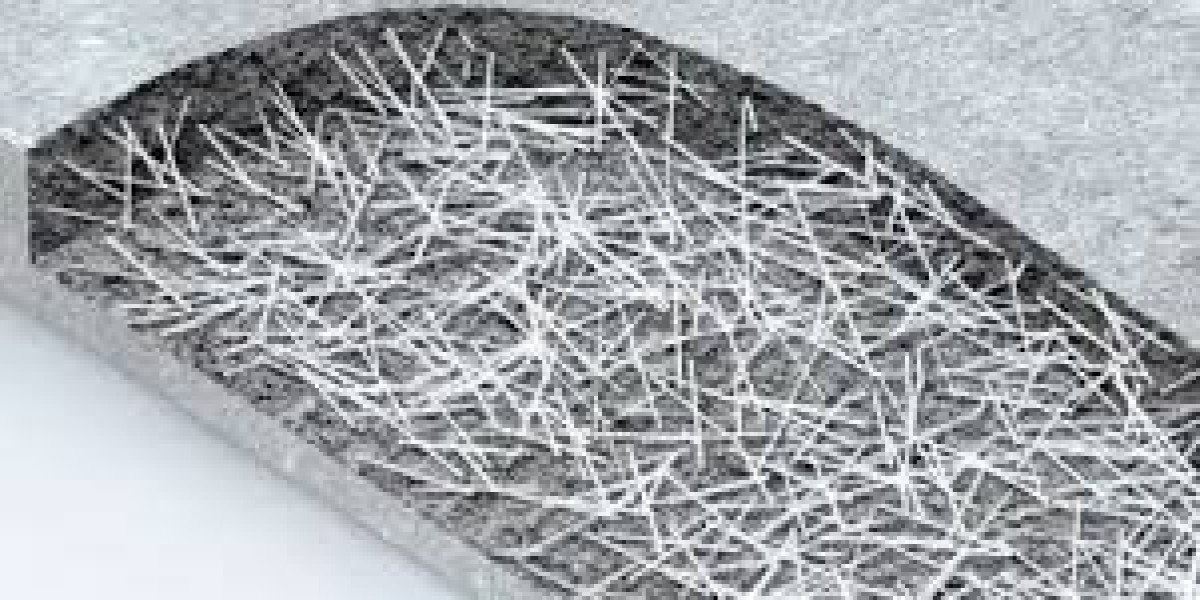

The global concrete fiber market is poised for strong expansion, driven by accelerating infrastructure development, rapid urbanization, and growing demand for durable and sustainable construction materials. Valued at US$ 2.3 Bn in 2024, the market is projected to grow at a CAGR of 7.8% from 2025 to 2035, reaching approximately US$ 5.3 Bn by the end of the forecast period. Increasing emphasis on long-lasting, crack-resistant, and high-performance concrete solutions is reshaping construction practices worldwide.
Market Overview
Concrete fibers are reinforcement materials mixed directly into concrete to enhance tensile strength, reduce cracking, and improve overall durability. Made from materials such as steel, glass, polypropylene, polyester, and carbon, these fibers are evenly distributed throughout the concrete mix during the batching process.
Fiber-reinforced concrete (FRC) is widely used in concrete slabs, precast components, industrial floors, sprayed concrete (shotcrete), screeds, and extruded concrete applications. By enhancing load-bearing capacity, controlling shrinkage cracks, and increasing impact resistance, concrete fibers extend the service life of structures while maintaining workability and performance.
As construction standards evolve, concrete fibers are becoming integral to transportation infrastructure, commercial buildings, residential projects, and large-scale industrial developments.
Rising Global Construction Demand
The expansion of the global construction sector is a key driver of market growth. Rapid urbanization, particularly in emerging economies, is increasing the demand for residential housing, commercial complexes, transportation networks, and industrial facilities.
Concrete remains a foundational building material, but traditional reinforced concrete systems often require additional steel rebar and complex installation processes. Fiber-reinforced concrete provides a cost-effective and efficient alternative by improving mechanical performance and reducing dependency on conventional reinforcement in many applications.
In infrastructure projects such as highways, bridges, airports, and tunnels, concrete fibers improve tensile strength, reduce permeability, and enhance resistance to heavy loads and environmental stress. Steel fiber-reinforced concrete, in particular, is widely used in heavy-duty applications where durability and crack control are critical.
Download Sample PDF Copy: https://www.transparencymarketresearch.com/sample/sample.php?flag=S&rep_id=6269
Sustainability Trends Accelerating Adoption
Sustainable construction practices are significantly influencing the adoption of concrete fibers. With increasing regulatory pressure to reduce carbon emissions and construction waste, fiber-reinforced concrete offers environmental advantages.
For instance, reducing traditional steel reinforcement lowers embodied carbon and energy consumption associated with steel production. Moreover, concrete fibers enhance durability and structural longevity, minimizing repair cycles and lifecycle costs. This aligns with green building standards and sustainability certifications being adopted globally.
Leading companies such as BASF SE and Sika AG are developing advanced fiber solutions that improve crack resistance, durability, and sustainability performance. In 2024, Sika AG introduced a macro-synthetic fiber aimed at enhancing impact resistance and durability in precast and industrial flooring applications.
Steel Fiber Dominates the Market
Among fiber types, steel fiber holds the dominant share due to its superior structural reinforcement capabilities. It significantly enhances tensile strength, impact resistance, and load-bearing capacity, making it ideal for tunnels, industrial flooring, bridges, and airport pavements.
Companies like Bekaert SA specialize in advanced steel fiber technologies tailored for demanding infrastructure applications. Meanwhile, synthetic fiber producers such as Propex Operating Company, LLC are gaining traction in residential and commercial segments due to lightweight and corrosion-resistant properties.
Regional Insights
Asia Pacific leads the global concrete fiber market, supported by large-scale infrastructure investments in China, India, and Southeast Asia. Rapid urban expansion, smart city initiatives, and government-backed transportation projects are fueling demand for high-performance concrete solutions in the region.
North America and Europe are also witnessing steady growth, particularly driven by infrastructure renovation, sustainable construction mandates, and technological innovation.
Competitive Landscape
The market is moderately consolidated, with players focusing on product innovation, sustainability improvements, and production capacity expansion. Companies such as Reliance, ABC Polymer Industries, and Nycon Corporation are strengthening their presence through advanced fiber solutions tailored to diverse construction needs.
Conclusion
The concrete fiber market outlook through 2035 remains highly positive, supported by infrastructure growth, urbanization, and sustainability-driven innovation. As construction stakeholders prioritize durability, performance, and environmental responsibility, fiber-reinforced concrete is expected to play an increasingly vital role in shaping the future of global infrastructure development.