
Automotive Door Panel Market Growth, Trends & Forecast (2024–2030)
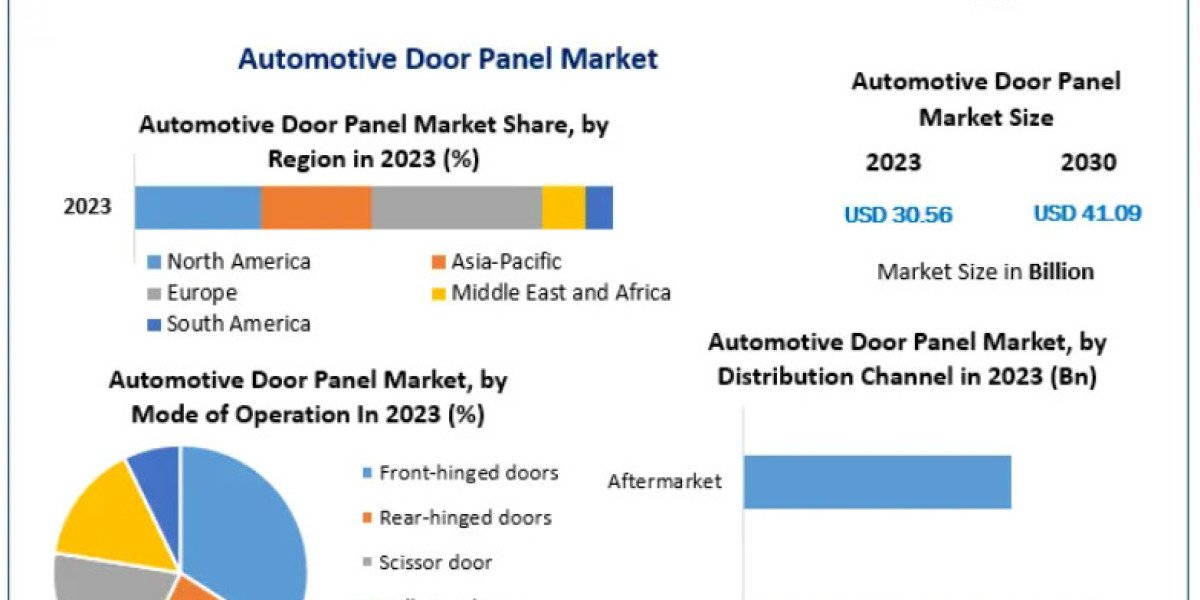
The global Automotive Door Panel Market is witnessing steady growth, driven by rising vehicle production, evolving consumer preferences, and technological advancements in automotive interiors. Valued at USD 30.56 billion in 2023, the market is projected to reach USD 41.09 billion by 2030, growing at a CAGR of 4.32% during the forecast period.
Market Overview
Automotive door panels play a critical role in enhancing vehicle aesthetics, comfort, and safety. Modern door panels integrate features such as control switches, storage compartments, ambient lighting, and advanced materials for noise insulation and impact protection. Increasing demand for premium interiors and lightweight components is pushing manufacturers to innovate continuously.
To know the most attractive segments, click here for a free sample of the report:https://www.maximizemarketresearch.com/request-sample/29967/
Key Growth Drivers
The market is primarily driven by:
- Rising passenger vehicle sales, fueled by growing middle-class income and urbanization
- Increasing demand for feature-rich and luxury interiors
- Growing focus on vehicle safety and ergonomics
- Technological advancements in lightweight and durable materials
- Expansion of automotive markets in emerging economies
Additionally, the surge in road accidents has increased the demand for reinforced and safety-enhanced door panels.
Market Opportunities
Significant opportunities are emerging from:
- Untapped developing markets in Asia-Pacific, Latin America, and Africa
- Increasing adoption of electric vehicles (EVs)
- Growing preference for customized and premium vehicle interiors
- Advancements in sustainable and recyclable materials
Countries like China and India are becoming major growth hubs due to rising disposable incomes and expanding automotive production.
Market Challenges
Despite strong growth potential, the industry faces several challenges:
- Fluctuating raw material prices impacting production costs
- Rising demand for compact and two-seater vehicles, limiting panel complexity
- Supply chain disruptions and cost pressures
Segment Analysis
By Mode of Operation
- Front-hinged doors dominate the market due to their safety and widespread use
- Gullwing doors are expected to grow at the fastest rate (CAGR ~6.48%) due to convenience in tight urban spaces
- Other segments include rear-hinged, scissor, and sliding doors
By Distribution Channel
- OEM (Original Equipment Manufacturers) segment holds the largest share
- Aftermarket is growing due to customization trends
By Vehicle Type
- Passenger cars (economy and premium) lead the market
- Increasing demand in LCVs and HCVs for durability and comfort
Regional Insights
- North America and Europe dominate due to high luxury vehicle demand
- Asia-Pacific is the fastest-growing region
- China accounts for over 31.9% of global luxury vehicle sales
- India is emerging as a high-potential market due to rapid economic growth
- Middle East & Africa and South America are witnessing gradual expansion
To know the most attractive segments, click here for a free sample of the report:https://www.maximizemarketresearch.com/request-sample/29967/
Competitive Landscape
Leading companies are focusing on product innovation, partnerships, and facility expansion to strengthen their market presence. Key players include:
- Grupo Antolin
- Brose
- Draexlmaier Group
- IAC Group
- Toyota Boshoku Corporation
- Yanfeng
- Aisin Corporation
- Faurecia
- Magna International
- Continental AG
These companies are investing heavily in R&D and sustainable materials to gain a competitive edge.
Emerging Trends
- Integration of smart features such as touch controls and ambient lighting
- Use of eco-friendly materials like bio-based plastics
- Increased focus on lightweight design for fuel efficiency
- Growth of modular door panel systems
Conclusion
The Automotive Door Panel Market is poised for consistent growth, supported by evolving consumer expectations, technological advancements, and rising global vehicle production. While cost fluctuations remain a concern, innovation and expansion into emerging markets will continue to drive the industry forward.